Cake delivery is where the magic meets the road.
You can bake the fluffiest sponge, whip the silkiest buttercream, pipe the neatest borders, stack the tallest tiers and decorate a cake so beautiful it deserves its own spotlight. But if that cake arrives late, tilted, cracked, melted, smudged or shaken into sadness, the customer will remember the delivery problem more than the hours of artistry behind it.
For bakers, cake delivery is not just transport. It is the final stage of the customer experience. It is the bridge between your kitchen and someone’s birthday party, wedding reception, baby shower, anniversary dinner, corporate event or family celebration.
That means cake delivery needs planning, not guesswork. From packaging and temperature control to delivery route planning and customer communication, every step matters. The goal is simple: get every cake to the right place, at the right time, in the right condition, with as little stress as possible.
Why Cake Delivery Deserves Serious Attention
Cakes are delicate cargo. Unlike parcels, they cannot simply be stacked, tossed into the back seat or left on a doorstep without care. A cake can be affected by heat, cold, sharp braking, uneven roads, humidity, poor packaging, long waits, traffic, incorrect addresses and rushed handovers.
For small bakeries and home bakers, delivery can quickly become one of the hardest parts of the business. A single cake delivery may be manageable. Five birthday cakes, two wedding cakes, twelve cupcake boxes and a dessert table setup across different postcodes is a very different challenge.
Good cake delivery planning helps bakers:
- Reduce damage
- Save time
- Cut fuel costs
- Avoid late arrivals
- Handle multiple orders efficiently
- Improve customer communication
- Protect profit margins
- Build a professional reputation
- Reduce stress on busy baking days
In other words, delivery is not just an operational detail. It is part of your brand.
Delivery Route Planning for Bakers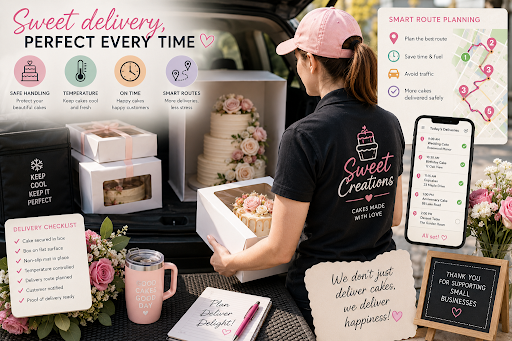
Delivery route planning is where bakers can move from “I hope this works” to “I know this plan makes sense.”
When you have multiple cake deliveries, the order of stops matters. A poor route can waste fuel, increase driving time, create stress and put delicate cakes at risk. A smart route protects your products and your schedule.
Modern route optimization is widely used in last-mile delivery because it helps reduce unnecessary miles, improve efficiency and meet customer expectations. Geotab notes that route optimisation helps businesses cut fuel use by reducing unnecessary travel and improving delivery performance.
For bakers, route planning should consider more than distance. You need to think about:
- Delivery time windows
- Cake fragility
- Temperature sensitivity
- Venue access
- Parking
- Road type
- Traffic
- Event start times
- Customer availability
- Setup time
- Driver capacity
- Return-to-kitchen needs
The shortest route on a map is not always the best cake route. A bumpy shortcut may be worse than a smoother main road. A venue with difficult parking may need extra time. A wedding cake should not be rushed between small local deliveries.
Start With the Cake: Not Every Cake Travels the Same Way
Before planning the route, think about the cake itself. Different cakes have different travel needs.
A single-tier buttercream cake may be fairly straightforward. A three-tier wedding cake with fresh flowers, sugar flowers or delicate piping may require more careful handling. Cupcakes need protection from sliding. Tall cakes may need central dowels. Cream-filled cakes may need stricter temperature control. Dessert tables may require a setup window, extra packaging and multiple carrying trays.
Ask these questions before every delivery:
- Is the cake tall, heavy or tiered?
- Does it contain fresh cream, mousse, custard or soft fillings?
- Does it need refrigeration?
- Is the finish buttercream, ganache, fondant or glaze?
- Are there fragile toppers, sugar flowers or decorative pieces?
- Will final assembly happen on site?
- Does the venue have stairs, parking restrictions or limited access?
- Can the recipient accept the cake at the agreed time?
The more delicate the cake, the more generous your delivery plan should be.
Packaging: The First Line of Defence
Cake delivery starts long before the car door opens. It starts with packaging.
A strong cake box, sturdy board and secure base can prevent many disasters. The cake should sit on a board that is the right size and strong enough for the weight. The box should be tall enough to avoid touching decorations, but not so oversized that the cake can move around. Any ingredients would ideally be in a sealed pouch packaging.
For taller cakes, consider reinforced boxes or extended-height cake boxes. For cupcakes, use inserts that hold each cupcake in place. For cookies, macarons, cake pops or mini desserts, use packaging that prevents shifting and crushing.
Good cake packaging should:
- Support the weight of the cake
- Prevent movement
- Protect decorations
- Allow safe lifting
- Keep dust and debris away
- Help maintain temperature
- Look professional at handover
A cake should never be free to slide inside its box. Non-slip mats, grip pads and level surfaces are simple but powerful tools.
Temperature Control: Keep Cakes Comfortable
Temperature is one of the biggest cake delivery risks. Buttercream can soften. Chocolate can bloom or melt. Cream fillings can become unsafe. Sugar decorations can sweat. Fresh flowers can wilt. Fondant can become sticky in humid conditions.
The USA and UKs Food Standards Agency’s Safer Food, Better Business guidance is designed to help small food businesses manage food safety properly, including safe preparation, storage and chilling procedures. Bakers delivering perishable products should treat delivery as part of their food safety process, not an afterthought.
For chilled or temperature-sensitive cakes, use insulated boxes, cool packs where appropriate, air-conditioned vehicles and short delivery windows. Avoid leaving cakes in parked vehicles, especially in warm weather. Even a few minutes in direct sun can change the condition of icing or fillings.
Food must be delivered safe and fit to eat, and the FSA’s transporting food guidance makes clear that safe transport is part of protecting the consumer.
Practical temperature tips for bakers:
- Chill cakes properly before transport when suitable.
- Pre-cool the vehicle in hot weather.
- Keep cakes out of direct sunlight.
- Use insulated carriers for sensitive products.
- Avoid opening boxes unnecessarily.
- Plan the shortest sensible route for temperature-sensitive orders.
- Tell customers how to store the cake after delivery.
The best delivery is not only pretty. It is safe.
The Vehicle Setup Matters
The safest place for a cake is usually a flat, level, secure surface. That normally means the boot or cargo area, not a sloped car seat.
Before delivery, prepare the vehicle:
- Clear unnecessary items
- Clean the loading area
- Use non-slip mats
- Check the surface is level
- Avoid stacking heavy items nearby
- Keep air conditioning or heating appropriate
- Carry emergency supplies
- Drive gently
Emergency supplies might include paper towels, gloves, small scissors, spare ribbon, a palette knife, extra buttercream, piping bags, dowels, tape, wipes, a small spirit level and spare decorations. For wedding cakes and large setup jobs, a repair kit can save the day.
How to Plan Multiple Cake Deliveries
When delivering several cakes in one trip, start by grouping orders geographically. Then layer in timing and cake sensitivity.
A practical approach:
- List every delivery address.
- Add required delivery time windows.
- Mark cakes that are fragile, tall, chilled or urgent.
- Estimate loading and handover time for each stop.
- Check traffic and parking.
- Build the route.
- Add buffer time.
- Confirm delivery details with customers.
- Pack the vehicle in reverse drop-off order.
Packing in reverse order matters. The first cake delivered should be easiest to access. You do not want to move three fragile boxes to reach one small cupcake order.
For example, a baker delivering five Saturday orders might plan like this:
- 9:00am: wedding cake to venue with setup
- 10:45am: birthday cake nearby
- 11:15am: cupcake box delivery
- 12:00pm: anniversary cake
- 12:30pm: dessert table items
But if the wedding cake is tall and delicate, it may be safer to deliver it alone first, then return for the smaller orders. Optimisation is not only about saving miles. It is about protecting the highest-risk cake.
Use Delivery Windows, Not Vague Times
One of the easiest ways to reduce delivery stress is to use delivery windows.
Instead of saying, “I’ll deliver in the morning,” give a realistic window such as:
“Your cake will arrive between 10:00am and 11:00am.”
Or:
“Wedding cake setup is scheduled for 9:30am to 10:30am.”
Delivery windows help customers plan. They also give you flexibility if traffic, parking or handover takes longer than expected.
For multi-drop days, avoid promising exact times unless you are certain. A 15-minute delay at one stop can affect every delivery after it.
Customer Communication Is Part of Delivery
Customers are usually excited about their cake. They may also be nervous, especially if it is for a big event. Good communication reassures them.
Before delivery, confirm:
- Full address
- Contact name
- Phone number
- Delivery date
- Delivery window
- Parking or access notes
- Whether someone will be available
- Storage instructions
- Venue contact if applicable
For weddings or large events, get the venue coordinator’s details. Confirm where the cake should be placed, whether the cake table is ready, whether fresh flowers are supplied separately, and whether final setup is required.
A simple delivery confirmation message can prevent a lot of problems.
Proof of Delivery
Proof of delivery is useful for cake businesses because it protects both the baker and the customer. For standard orders, this might be a quick photo of the boxed cake at handover. For wedding cakes, take photos after setup from several angles.
Delivery management platforms often include proof of delivery, customer notifications and driver tracking. A recent review of Onfleet, for example, described it as a last-mile delivery platform focused on task assignment, real-time driver tracking, proof of delivery and customer communication.
Bakers may not need advanced software at the start, but the principles are helpful:
- Record delivery time.
- Take a photo where appropriate.
- Note the person who accepted the cake.
- Photograph the cake after venue setup.
- Keep communication records.
- Document any access or storage issues.
This is especially important for high-value wedding cakes or corporate orders.
Route Planning Software for Cake Delivery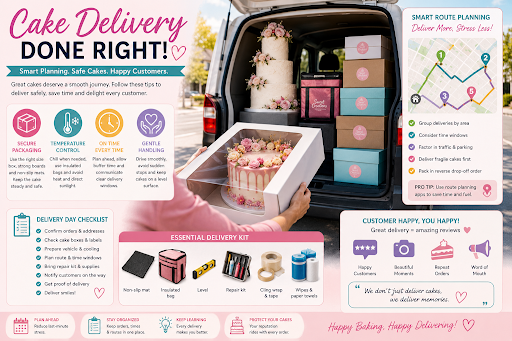
As a cake business grows, manual route planning can become time-consuming. Route planning software can help organise multiple deliveries more efficiently.
Useful features include:
- Multi-stop route optimisation
- Delivery time windows
- Driver assignment
- Live traffic awareness
- Customer notifications
- Proof of delivery
- Estimated arrival times
- Mobile driver apps
- Delivery notes
- Route history
For a small bakery, even a simple route planner can help. For a larger bakery with multiple drivers, delivery software can become a serious operational advantage.
Last-mile delivery is often complex because routes must account for time windows, driver capacity, traffic, customer preferences and real-world constraints. Research into last-mile routing commonly treats delivery planning as a vehicle routing problem, where the aim is to find efficient ways to serve multiple stops while respecting constraints. (arXiv)
For cake delivery, those constraints are very real: fragile products, event deadlines and limited tolerance for delays.
Build Buffer Time Into Every Route
Cake delivery should never be planned to the minute. Leave buffer time.
You may need extra time for:
- Traffic
- Roadworks
- Parking
- Finding the correct entrance
- Waiting for someone to answer
- Venue staff delays
- Lift or stair access
- Cake table preparation
- Final assembly
- Taking setup photos
- Customer questions
A delivery route that looks efficient but has no buffer is fragile. One problem can collapse the whole schedule.
For wedding cakes and large event cakes, add more buffer than you think you need. Arriving early and calm is better than arriving late and flustered.
Charge Properly for Delivery
Cake delivery costs money. It uses time, fuel, vehicle wear, packaging, insurance, staff and admin. Many bakers undercharge because they feel uncomfortable adding delivery fees.
But delivery is a professional service. It protects the cake and gives the customer convenience.
A delivery fee can be based on:
- Distance
- Travel time
- Setup time
- Cake complexity
- Parking costs
- Congestion charges
- Ferry or toll costs where relevant
- Number of items
- Same-day urgency
- Staff required
For wedding cakes, delivery and setup should usually be priced separately from the cake itself. A three-tier cake that requires careful transport, assembly and venue coordination is not the same as handing over a boxed birthday cake at the bakery door.
Decide When Not to Deliver
Not every delivery request is sensible. Sometimes collection is better. Sometimes the customer needs to arrange specialist transport. Sometimes the cake design should be adjusted to travel safely.
You may need to decline or modify delivery when:
- The route is too long for the cake type.
- The customer wants delivery too close to event start time.
- The cake is too fragile for the requested journey.
- The venue has unsafe access.
- Weather conditions create risk.
- There is no safe storage at the destination.
- The budget does not cover proper delivery.
It is better to set boundaries than risk a damaged cake and unhappy customer.
Make Cakes More Delivery-Friendly
Cake design can support better delivery. A beautiful cake should also be structurally sensible.
Delivery-friendly design choices include:
- Strong internal support
- Correct dowelling
- Stable cake boards
- Chilled buttercream before travel
- Secure toppers packed separately where needed
- Assembling delicate decorations on site
- Avoiding overly soft fillings for long journeys
- Using ganache under fondant for stability where appropriate
- Separating tiers for transport if necessary
- Keeping tall cakes balanced
If a customer wants a design that is risky for transport, explain the options. Most customers appreciate honesty when it protects their cake.
Wedding Cake Delivery: The High-Stakes Version
Wedding cake delivery deserves its own process. These cakes are often expensive, emotional and highly photographed. They may also involve multiple suppliers, tight venue schedules and delicate decorations.
Before the wedding day, confirm:
- Venue address
- Coordinator contact
- Delivery window
- Cake table location
- Parking and loading access
- Whether the table will be ready
- Room temperature
- Fresh flower arrangements
- Stand or separator setup
- Final styling requirements
- Emergency contact
On arrival, inspect the table before placing the cake. Make sure it is stable, level and away from direct sunlight, heaters or heavy foot traffic.
After setup, take clear photos. These protect you and also give you content for your portfolio.
Keep Records and Learn From Every Delivery
Every delivery teaches you something. Track what works and what causes problems.
Record:
- Delivery distance
- Time taken
- Parking issues
- Customer delays
- Damage incidents
- Weather problems
- Packaging performance
- Driver notes
- Customer feedback
- Actual cost versus delivery fee
Over time, this information helps you price delivery better, plan routes more accurately and avoid repeat mistakes.
Cake Delivery Checklist
Before leaving the bakery or kitchen, check:
- Cake is fully chilled or set where appropriate.
- Decorations are secure.
- Box is the correct size.
- Cake board is strong enough.
- Label is correct.
- Delivery address is confirmed.
- Customer phone number is available.
- Storage instructions are included.
- Vehicle is clean and cool.
- Non-slip mat is in place.
- Route is planned.
- Buffer time is included.
- Repair kit is packed.
- Proof of delivery process is ready.
A checklist may feel simple, but on a busy morning it can prevent expensive mistakes.
SEO FAQ: Cake Delivery and Route Planning
How do bakeries deliver cakes safely?
Bakeries deliver cakes safely by using strong packaging, flat transport surfaces, non-slip mats, temperature control, careful driving, realistic delivery windows and proper route planning.
What is the best way to transport a cake?
The best way to transport a cake is in a sturdy box on a flat, level surface, ideally in a cool vehicle. The cake should be secured so it cannot slide, tilt or touch the sides of the box.
How can bakers optimise multiple cake deliveries?
Bakers can optimise multiple cake deliveries by grouping stops geographically, using delivery windows, planning routes around fragile cakes, packing the vehicle in reverse drop-off order, allowing buffer time and using route planning software where needed.
Should cake businesses use route planning software?
Route planning software can be useful for cake businesses with multiple deliveries, tight time windows or more than one driver. It can help reduce travel time, improve customer communication and provide proof of delivery.
How do you keep cakes cool during delivery?
Cakes can be kept cool using chilled storage before departure, air-conditioned vehicles, insulated carriers, cool packs where suitable and short delivery windows. Perishable cakes should be managed according to food safety requirements.
To Round UP:
Cake delivery is the final flourish in the baking process. It is the moment your work leaves your hands and becomes part of someone’s celebration. That makes it exciting, but it also makes it important.
The best cake delivery systems combine creativity with discipline. Beautiful packaging, careful driving, temperature awareness, route planning, customer communication and proof of delivery all work together to protect the cake and the customer experience.
For bakers, optimising delivery is not about becoming a courier company. It is about respecting the value of your own work. Every cake represents ingredients, time, skill, reputation and trust.
Plan the route. Secure the box. Keep it cool. Communicate clearly. Leave a little buffer. Take the delivery seriously.
Because when a cake arrives safely, beautifully and on time, the celebration starts exactly as it should: with smiles, photos and someone saying, “Wow, that looks amazing.”
For more business hints and tips head to our Business Boot Camp tutorials.