Where Should You Spend and Where Should You Save on Cake Ingredients?
The cost of cake ingredients has risen considerably, but saving money doesn’t have to mean lowering the quality of your cakes. The trick is knowing where spending more makes a genuine difference and where you’re simply paying more for the name on the packet.
It’s a conversation Paul and I have had many times over the years.
Paul approaches it as the cake maker. He wants the ingredients that give him the flavour, texture and finish he’s looking for. I’m normally looking at the other side and asking, “Yes, but does spending another £5 actually make the cake £5 better?”. As ingredients are now so costly, more than ever it is important to minimise waste. If you need to re-size your cake recipe remember to use our Re-Sizing Calculator which takes the guess work away and will reduce waste.
Between us, we usually find the sensible middle ground. However, if you run a small cake business on your own, you’re probably having both sides of that conversation with yourself!
Where is it worth spending more?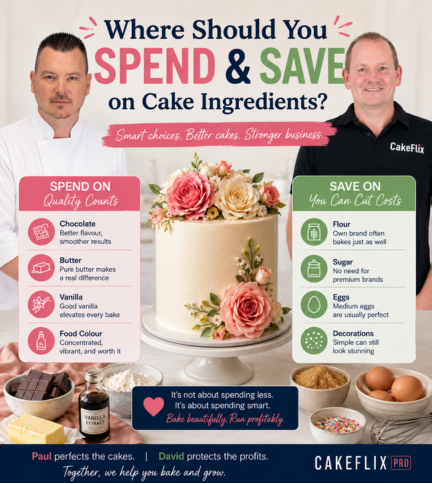
Some ingredients have a big influence on the finished cake.
Chocolate is a good example. Better chocolate can transform the flavour and texture of ganache. Likewise, if vanilla is an important flavour in a recipe, a good-quality product can make a noticeable difference.
Paul’s approach is simple. If the customer can taste or see the difference, quality matters.
The same applies to decorating products. Reliable sugarpaste, colours and specialist ingredients can save considerable time and frustration. A cheaper product isn’t much of a saving if you need twice as long to work with it.
Where can you save?
This is where my calculator comes out!
Do you need a premium brand of caster sugar? Does a more expensive bag of flour produce a noticeably better sponge? Could you buy frequently used cake ingredients in larger quantities?
Supermarket own brands can offer excellent value for basic ingredients. However, test them before changing an established recipe.
Also look beyond the price on the packet. Buying 10kg instead of 1kg might appear cheaper, but not if you eventually throw 3kg away.
Waste is one of the most expensive ingredients in any cake business.
Don’t forget your time
Paul might save £2 on a decorating product, only for it to take him an extra 20 minutes to achieve the finish he wants.
Suddenly my £2 saving doesn’t look quite so clever!
For a business, your time has a value too. Always consider cost, quality and time together.
What if you sell your cakes?
Don’t quietly absorb every ingredient price increase.
Review the cost of your regular recipes from time to time. If ingredients have increased significantly, your prices may need to change too. Review your ingredient costs against the price you are charging, which should be around 30%. Pricing is usually the reason why some business fail and others succeed. Learn more about pricing cakes on our Business Boot Camp.
You don’t necessarily need dramatic price rises. Small adjustments, sensible purchasing and reducing waste can collectively protect your margin.
Find your own balance
Paul and I approach cake making from different directions. He protects the quality. I tend to protect the numbers. Neither works particularly well without the other.
If you’re doing both jobs yourself, remember that reducing costs doesn’t mean becoming a cheaper cake maker.
Spend where your customer can see or taste the difference. Save where they can’t. Reduce waste wherever possible. And never forget to put a value on your own time.
That’s not cutting corners. That’s running a smarter cake business. If you take one thing away from this post it would be to immediately review your ingredient costs against the prices you are charging. Let us know how you get on at the CakeFlix Family Facebook Group.
Thanks for taking the time to read this article.
Sign up today and get full access to the world's biggest dedicated online resource for cake decorators. We can't wait to see you there! - Paul & David