Welcome to the Cake Decorators Q&A

Baking a Cake in One Tin Instead of Two: Times and Tips
Hi there, I’m new to baking so any advice would be greatly appreciated 🙂 Is it better to cook the cake in two halves or bake a deep one and cut it? I will be using the recipes recommended on here…
CakeFlix Guidance
Is it better to bake two shallow cakes or one deep cake?
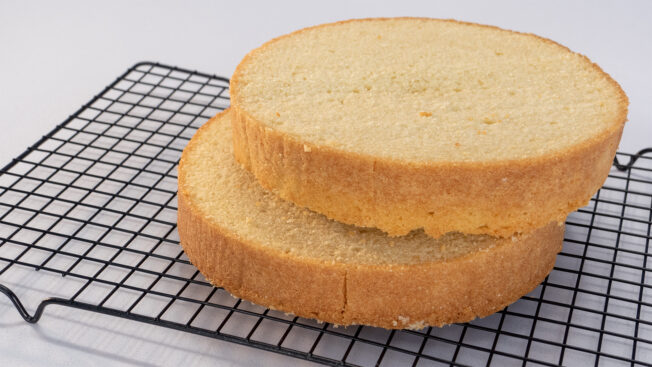
Bake the Perfect Cake – CakeFlix Diploma
Both methods can work. For a light sponge sandwich cake, two shallower layers are usually the simpler option: they bake more quickly and you do not need to slice a deep cake horizontally. One deeper cake can also produce good results, provided the recipe suits a deeper bake and you allow enough time for the centre to cook.
If you want two finished layers approximately 1½ inches deep, you can either bake them separately or bake one cake approximately 3 inches deep and split it after cooling. The right choice depends on your recipe, tin size and how confident you feel cutting even layers.
These measurements describe the baked cake, not the depth of raw batter. Always leave room for the mixture to rise.
Baking two cakes separately
Dividing the mixture evenly between two matching tins makes it easier to produce similar-sized layers. Weighing the batter into each tin helps keep them consistent.
Shallower layers generally cook more quickly, reducing the time the outside spends baking while the centre sets. This can be helpful with lighter sponge recipes.
The disadvantages are needing two tins and enough oven space. You may also need to level two domed tops rather than one. Leave space around the tins for air to circulate and follow your recipe’s shelf-position guidance.
Baking a cake in one tin instead of two
One deep tin can be convenient if you only have one suitable tin or prefer to slice your cake into layers afterwards. There is only one top to level, which may reduce trimming.
However, the centre takes longer to bake. The outside can become dry or over-coloured before the middle is ready, particularly if the tin is overfilled or the temperature is unsuitable.
Use a sufficiently deep tin of the correct diameter. As a general guide, avoid filling it more than two-thirds full unless your recipe specifically instructs otherwise. Some recipes require more headroom.
For the most predictable result, use a recipe tested in a deep tin rather than assuming every sandwich sponge will behave the same way.
How long should you cook a sponge cake in one tin?
There is no single baking time for a sponge cake baked in one tin. Diameter, batter depth, recipe, tin material and oven performance all affect the result. Do not automatically double the time given for two separate layers.
For context, Nigella’s guidance gives an example of an 8-inch sponge taking approximately 25–30 minutes in two shallow tins, compared with 50–55 minutes in one deeper tin. These are illustrative timings, not a reliable schedule for every sponge.
Read Nigella’s guidance on sandwich tins versus deep cake tins.
Follow a tested recipe wherever possible. When adapting a recipe, watch the cake’s progress and check for doneness rather than relying on the clock alone.
How long should you bake a cake in a 3-inch-deep pan?
A pan’s height does not determine the baking time. A 3-inch-deep tin containing a shallow layer of batter will bake differently from the same tin holding enough mixture for a taller cake.
An 8-inch cake and a 12-inch cake also need different consideration, even if both tins have 3-inch sides.
Check that the centre is set, the surface gently springs back when touched and a skewer comes out without wet batter. Some moist chocolate recipes may leave a few damp crumbs, so use the recipe’s own doneness guidance.
If the top is becoming too dark while the centre finishes, loosely cover it with foil once the surface has set. Avoid repeatedly opening the oven early in baking.
Should you change the oven temperature?
Start with the temperature specified for your recipe and oven type.
A deeper version of a shallow-layer recipe may benefit from a slightly lower temperature and longer baking, but there is no universal adjustment. Following instructions for a comparable deep cake is more reliable than choosing a new temperature by guesswork.
Make sure you distinguish conventional and fan oven settings.
If you halve a cake recipe, do you halve the baking time?
No. Halving the ingredients does not mean halving the baking time. The important consideration is how the amount of mixture changes its depth in the tin.
If a recipe makes two matching sponge layers and you halve it to bake just one layer in the same-sized tin, the baking time will usually remain close to the original time for an individual layer.
If you put half the mixture into the original single tin, the batter will be shallower and may cook sooner. If you use a smaller tin that maintains a similar batter depth, the time may remain closer to the original.
Nigella’s advice on making a single cake layer illustrates why halving a two-layer recipe does not necessarily shorten its baking time.
For help adjusting ingredient quantities, use the CakeFlix Cake Recipe Re-Calculator. Remember that ingredient scaling does not provide a guaranteed baking time.
When should you cut a cake in half after baking?
Allow the cake to cool completely before cutting it horizontally. A warm sponge is more fragile and can tear, crumble or compress as you slice it.
Follow the recipe’s instructions for resting in the tin and turning out onto a cooling rack. A deep cake can feel cool outside while still holding warmth in the middle.
Once completely cooled, use a cake leveller or a long serrated knife. Mark the halfway point around the cake and work gradually around it, keeping the blade level. Brief chilling can make some delicate cakes easier to handle, but is not essential for every sponge.
Can you bake the layers one after another?
Yes, but leaving a mixed sponge batter waiting through an entire baking cycle can affect its rise.
If your recipe does not specifically allow the batter to stand, the more reliable approach is to prepare two separate half batches. Bake the first, then let the tin cool before cleaning, preparing and filling it again.
Can you half-bake a cake and finish it later?
Do not plan to partially bake a sponge, let it cool and finish baking it later. The structure may collapse before it sets, and reheating will not reliably restore the rise or texture.
Instead, bake the cake fully in one session. Once cooled, wrap and store or freeze it as appropriate for the recipe, ready to fill and decorate later.
Our recommendation
For a straightforward sponge sandwich cake, bake two separate layers if that is what the recipe specifies. If you prefer one taller cake to split afterwards, choose a recipe designed for a deep tin.
Both approaches can make an excellent cake. Matching the recipe, batter quantity and tin is more important than choosing one method for every bake.
Build your baking confidence with CakeFlix
Explore baking and fillings in the CakeFlix Diploma, with 39 lessons across the complete programme. Your membership also includes access to 1,800+ tutorials from over 100 expert tutors.
Explore CakeFlix membership from the equivalent of £5.17 per month, billed annually at £62, and develop your baking and decorating skills step by step.
Need more Important Information on Baking and Cake Decorating?
Learning about how to make and store ganache is just one of 39 lessons covered in the CakeFlix Diploma, which, along with 1,800+ tutorials from 100+ of the world’s top cake artists, comes as part of your CakeFlix membership from only £5.17 a month (billed annually).
CakeFlix Diploma – Certified Learning

Hi there, I’m new to baking so any advice would be greatly appreciated 🙂 Is it better to cook the cake in two halves or bake a deep one and cut it? I will be using the recipes recommended on here…
CakeFlix Guidance
Is it better to bake two shallow cakes or one deep cake?
Bake the Perfect Cake – CakeFlix Diploma
Both methods can work. For a light sponge sandwich cake, two shallower layers are usually the simpler option: they bake more quickly and you do not need to slice a deep cake horizontally. One deeper cake can also produce good results, provided the recipe suits a deeper bake and you allow enough time for the centre to cook.
If you want two finished layers approximately 1½ inches deep, you can either bake them separately or bake one cake approximately 3 inches deep and split it after cooling. The right choice depends on your recipe, tin size and how confident you feel cutting even layers.
These measurements describe the baked cake, not the depth of raw batter. Always leave room for the mixture to rise.
Baking two cakes separately
Dividing the mixture evenly between two matching tins makes it easier to produce similar-sized layers. Weighing the batter into each tin helps keep them consistent.
Shallower layers generally cook more quickly, reducing the time the outside spends baking while the centre sets. This can be helpful with lighter sponge recipes.
The disadvantages are needing two tins and enough oven space. You may also need to level two domed tops rather than one. Leave space around the tins for air to circulate and follow your recipe’s shelf-position guidance.
Baking a cake in one tin instead of two
One deep tin can be convenient if you only have one suitable tin or prefer to slice your cake into layers afterwards. There is only one top to level, which may reduce trimming.
However, the centre takes longer to bake. The outside can become dry or over-coloured before the middle is ready, particularly if the tin is overfilled or the temperature is unsuitable.
Use a sufficiently deep tin of the correct diameter. As a general guide, avoid filling it more than two-thirds full unless your recipe specifically instructs otherwise. Some recipes require more headroom.
For the most predictable result, use a recipe tested in a deep tin rather than assuming every sandwich sponge will behave the same way.
How long should you cook a sponge cake in one tin?
There is no single baking time for a sponge cake baked in one tin. Diameter, batter depth, recipe, tin material and oven performance all affect the result. Do not automatically double the time given for two separate layers.
For context, Nigella’s guidance gives an example of an 8-inch sponge taking approximately 25–30 minutes in two shallow tins, compared with 50–55 minutes in one deeper tin. These are illustrative timings, not a reliable schedule for every sponge.
Read Nigella’s guidance on sandwich tins versus deep cake tins.
Follow a tested recipe wherever possible. When adapting a recipe, watch the cake’s progress and check for doneness rather than relying on the clock alone.
How long should you bake a cake in a 3-inch-deep pan?
A pan’s height does not determine the baking time. A 3-inch-deep tin containing a shallow layer of batter will bake differently from the same tin holding enough mixture for a taller cake.
An 8-inch cake and a 12-inch cake also need different consideration, even if both tins have 3-inch sides.
Check that the centre is set, the surface gently springs back when touched and a skewer comes out without wet batter. Some moist chocolate recipes may leave a few damp crumbs, so use the recipe’s own doneness guidance.
If the top is becoming too dark while the centre finishes, loosely cover it with foil once the surface has set. Avoid repeatedly opening the oven early in baking.
Should you change the oven temperature?
Start with the temperature specified for your recipe and oven type.
A deeper version of a shallow-layer recipe may benefit from a slightly lower temperature and longer baking, but there is no universal adjustment. Following instructions for a comparable deep cake is more reliable than choosing a new temperature by guesswork.
Make sure you distinguish conventional and fan oven settings.
If you halve a cake recipe, do you halve the baking time?
No. Halving the ingredients does not mean halving the baking time. The important consideration is how the amount of mixture changes its depth in the tin.
If a recipe makes two matching sponge layers and you halve it to bake just one layer in the same-sized tin, the baking time will usually remain close to the original time for an individual layer.
If you put half the mixture into the original single tin, the batter will be shallower and may cook sooner. If you use a smaller tin that maintains a similar batter depth, the time may remain closer to the original.
Nigella’s advice on making a single cake layer illustrates why halving a two-layer recipe does not necessarily shorten its baking time.
For help adjusting ingredient quantities, use the CakeFlix Cake Recipe Re-Calculator. Remember that ingredient scaling does not provide a guaranteed baking time.
When should you cut a cake in half after baking?
Allow the cake to cool completely before cutting it horizontally. A warm sponge is more fragile and can tear, crumble or compress as you slice it.
Follow the recipe’s instructions for resting in the tin and turning out onto a cooling rack. A deep cake can feel cool outside while still holding warmth in the middle.
Once completely cooled, use a cake leveller or a long serrated knife. Mark the halfway point around the cake and work gradually around it, keeping the blade level. Brief chilling can make some delicate cakes easier to handle, but is not essential for every sponge.
Can you bake the layers one after another?
Yes, but leaving a mixed sponge batter waiting through an entire baking cycle can affect its rise.
If your recipe does not specifically allow the batter to stand, the more reliable approach is to prepare two separate half batches. Bake the first, then let the tin cool before cleaning, preparing and filling it again.
Can you half-bake a cake and finish it later?
Do not plan to partially bake a sponge, let it cool and finish baking it later. The structure may collapse before it sets, and reheating will not reliably restore the rise or texture.
Instead, bake the cake fully in one session. Once cooled, wrap and store or freeze it as appropriate for the recipe, ready to fill and decorate later.
Our recommendation
For a straightforward sponge sandwich cake, bake two separate layers if that is what the recipe specifies. If you prefer one taller cake to split afterwards, choose a recipe designed for a deep tin.
Both approaches can make an excellent cake. Matching the recipe, batter quantity and tin is more important than choosing one method for every bake.
Build your baking confidence with CakeFlix
Explore baking and fillings in the CakeFlix Diploma, with 39 lessons across the complete programme. Your membership also includes access to 1,800+ tutorials from over 100 expert tutors.
Explore CakeFlix membership from the equivalent of £5.17 per month, billed annually at £62, and develop your baking and decorating skills step by step.
Need more Important Information on Baking and Cake Decorating?
Learning about how to make and store ganache is just one of 39 lessons covered in the CakeFlix Diploma, which, along with 1,800+ tutorials from 100+ of the world’s top cake artists, comes as part of your CakeFlix membership from only £5.17 a month (billed annually).
CakeFlix Diploma – Certified Learning
Hi Claire
It depends what you’re baking. Sponge cakes can be baked in two halves but fruit cakes must be baked in deep tins because they take a long time to bake at very low heat. If you bake sponge cakes in two halves the timing will be reduced.
Eg an 8″ cake baked in 2 shallow tins takes between 25 – 35 minutes and one deep 8″ cake will take approx 50 -55 minutes. I prefer to bake in one deep tin, other people prefer baking in two shallower tins. Advantages here of course is not having to layer the cakes. I also prefer baking mud cakes/ Paul’s moist chocolate cake in deep tins on lower heat for longer to allow the batter time to set up and bake properly. I’m sure other members will share their preferences.

I made Mrs Jones Sponge cake on here and made a mistake – I did not see that you had to use two tine! I baked in one tin, but took twice as long, obviously, but when I cut it in half to layer up, it was okay. The advantage of baking in one tin is that you only have one dome to remove, so less wastage.

Mrs Jones’ sponge cake is great, when baked in the two tins and each cake halved makes a fantastic tower. Just love it!
Ok thank you :-). I seem to be ok with friut cake but I just wondered if any one had a preference & why for sponge cakes. When I have tried deep tin sponges in th past they do not cook as well inside (bit soggy!) so perhaps the temperature needs to be lower! Ideally I’d like a light fluffy moist vanilla & chocolate sponge that can withhold being decorated! I suppose practice makes perfect! 🙂 I’d better get baking!