AI in cake decorating is no longer a distant conversation. It is happening right now, in your inbox, in your client consultations, and across every social media platform you use. Clients are arriving with AI-generated cake images and asking you to make them. So I want to talk to you honestly about what this means — because after 30 years in this industry, including creating cakes for the Late Queen Elizabeth II, King Charles, and Prince Albert of Monaco, I have learned one thing above all else: the craft always wins.
The other challenge being that newbie cake decorators with little experience, training or knowledge can create a superb portfolio of cakes that they have never made!
What Is AI Actually Doing in Our Industry?
AI tools such as lumenor can now generate photorealistic images of cakes in seconds. They look extraordinary. Gravity-defying tiers, impossible sugar flowers, textures that seem to glow from within. The problem is that many of these images are physically unbuildable. AI has no understanding of weight, structure, sugar chemistry, or the laws of physics. It simply generates what looks beautiful, not what is possible.
This is creating a real challenge for cake artists everywhere. Clients see an AI-generated image online, fall in love with it, and bring it to you expecting an exact replica. Managing that conversation — with confidence and professionalism — is one of the most important skills you can develop right now.
Why Your Skills Matter More Than Ever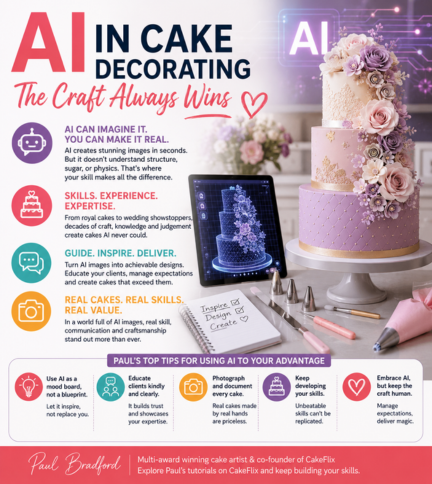
When I create my cakes, every decision — from the internal structure to the hand-painted details — comes from decades of accumulated skill and judgement. No AI can replicate that. No AI knows how sugar behaves in humidity, how a tiered cake distributes weight, or how to make a client feel that their most important celebration has been understood and honoured.
AI can inspire. It can help you explore colour palettes, present mood boards to clients, or sketch out initial design concepts more quickly than ever before. Used well, AI in cake decorating is a useful creative tool. Used poorly — or misunderstood — it creates unrealistic expectations that damage client relationships and undervalue your expertise.
When I made the cake for Prince Albert of Monaco, the brief was clear and the standards were high. However, during the consultation with his head chef I ensured that I retained an element of creative license. To add to the drama I was teaching to a class of 200 Italian Cuisine students when the news came through that Price Albert now wanted the cake a day early – that day! That is the reality of professional cake artistry. Just as well I added in that creative license! If I had provided an AI graphic, the expectation would have led to disappointment regardless of how much time I had. Managing your client’s expectations is down to you, your knowledge and skill, but most importantly your communication skills.
How to Handle the AI Image Conversation With Clients
When a client presents you with an AI-generated image, resist the urge to simply say no. Instead, treat it as a starting point. Ask what they love about it — the colour, the shape, the feeling it creates. Then use your expertise to design something that captures that essence within the boundaries of what is actually achievable. In my experience, clients who feel heard and guided always end up happier than those who are simply told what cannot be done.
Paul’s Top Tips for Navigating AI in Cake Decorating
- Use AI as a mood board tool, not a blueprint. Gather AI images that inspire a direction, then let your own design skills take over from there.
- Educate your clients kindly but clearly. A brief explanation of why certain AI designs are not buildable actually increases your perceived expertise, not reduces it.
- Photograph and document everything you make. As AI-generated imagery floods social media, real photographs of real cakes made by skilled hands become more valuable, not less.
- Keep developing your technical skills. The cake artists who thrive in the next decade will be those whose skills are so strong they cannot be replicated by a prompt. Browse our full tutorial library on CakeFlix to keep building yours.
- Do not compete with AI. It is here, its an effective tool so use it. However, ensure that clients expectations are managed carefully.
The Craft Always Wins
I have been privileged to create cakes that marked moments of genuine historical significance. None of those commissions came to me because I was the fastest or the cheapest. They came because of trust, reputation, and an level of skill built over decades. AI is a new chapter in our industry, but it is not the end of yours. It is, if anything, an opportunity to remind the world why real cake artistry matters.
Keep learning. Keep creating. The craft always wins.

Paul Bradford is a multi-award winning cake artist and co-founder of CakeFlix, the world’s leading online cake decorating tutorial platform. Explore Paul’s tutorials here.