Welcome to the Cake Decorators Q&A

How to Fix a Sweating Cake: Buttercream, Fondant and Condensation
When I ganache my cakes I leave them to firm up in the fridge but when I get them out they have alot of condensation so when I ice my cakes my fondant starts sweating!? I had to leave them in the fridge unless my colour starts to run… what am I doing wrong? Please this would be a great help ??
CakeFlix Guidance
Why is my cake sweating?
A cake often “sweats” when its cold surface meets warmer, humid air. Moisture from the air condenses into droplets on the buttercream, ganache or fondant, much like water appearing on a cold drinking glass.
At CakeFlix, our first suggestion is to check whether you are seeing condensation or a coating that is melting or separating. Clear surface droplets after refrigeration suggest condensation. Greasy patches or sliding icing may need a different solution.
How do you fix a sweating buttercream cake?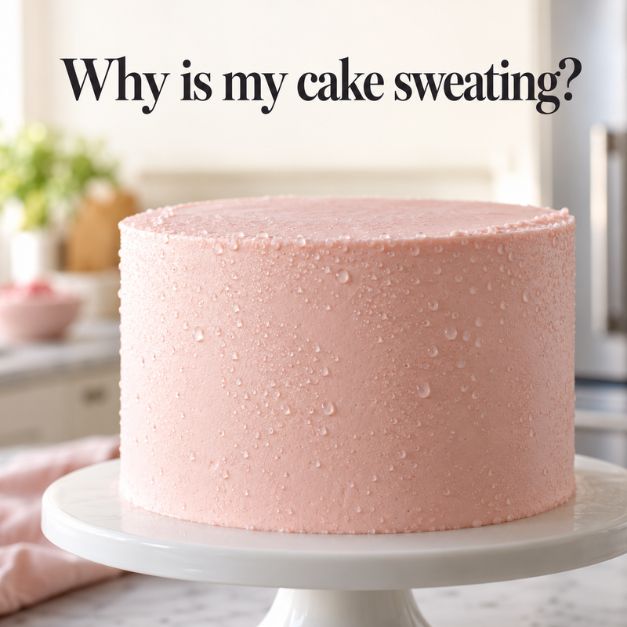
Move the cake somewhere cool and dry, away from sunlight, steam and direct heat. If its ingredients allow a short period outside refrigeration, let the moisture evaporate without touching the finish.
Avoid wiping soft buttercream, as this can leave marks or smear colours. Gentle airflow may help, but use a clean fan positioned away from the cake. A fan does not refrigerate food or make a warm room suitable for storage.
If the coating is becoming soft, prioritise keeping the cake appropriately chilled rather than waiting for a perfect surface.
How do you stop fondant from sweating?
Where possible, avoid sudden changes between a cold fridge and a hot, humid room. A clean, closed cake box can help reduce direct exposure during the transition, although it cannot guarantee a condensation-free finish.
Leave wet fondant untouched until the surface dries. Rubbing it or adding icing sugar can damage decorations or leave visible patches.
Before covering a ganached cake, check that the coating is firm and free from surface moisture. Our guide to decorating frozen and chilled cakes explains why temperature matters.
Why is my cake sweating in the fridge?
Moisture may collect if a warm cake is covered or refrigerated before cooling, or when warm air enters around a cold cake. Check your fridge temperature, storage container and cooling method.
However, not every wet patch is condensation. If your ganache looks greasy, read our advice on fixing oily ganache. For filling and coating quantities, see our buttercream guide.
Should I avoid refrigerating decorated cakes?
No. Storage must suit the ingredients, even when refrigeration makes decorating more challenging. Fresh cream and other perishable fillings require appropriate chilling. Fondant does not remove that requirement.
Follow recipe-specific instructions and read the official guidance on storing cakes safely.
For future bakes, plan your sponge baking schedule around decorating and serving. Explore the CakeFlix Diploma for structured learning to build your confidence.
Need more Important Information on Baking and Cake Decorating?
Learning about how to make and store ganache is just one of 39 lessons covered in the CakeFlix Diploma, which, along with 1,800+ tutorials from 100+ of the world’s top cake artists, comes as part of your CakeFlix membership from only £5.17 a month (billed annually).

CakeFlix Diploma – Certified Learning

When I ganache my cakes I leave them to firm up in the fridge but when I get them out they have alot of condensation so when I ice my cakes my fondant starts sweating!? I had to leave them in the fridge unless my colour starts to run… what am I doing wrong? Please this would be a great help ??
CakeFlix Guidance
Why is my cake sweating?
A cake often “sweats” when its cold surface meets warmer, humid air. Moisture from the air condenses into droplets on the buttercream, ganache or fondant, much like water appearing on a cold drinking glass.
At CakeFlix, our first suggestion is to check whether you are seeing condensation or a coating that is melting or separating. Clear surface droplets after refrigeration suggest condensation. Greasy patches or sliding icing may need a different solution.
How do you fix a sweating buttercream cake?
Move the cake somewhere cool and dry, away from sunlight, steam and direct heat. If its ingredients allow a short period outside refrigeration, let the moisture evaporate without touching the finish.
Avoid wiping soft buttercream, as this can leave marks or smear colours. Gentle airflow may help, but use a clean fan positioned away from the cake. A fan does not refrigerate food or make a warm room suitable for storage.
If the coating is becoming soft, prioritise keeping the cake appropriately chilled rather than waiting for a perfect surface.
How do you stop fondant from sweating?
Where possible, avoid sudden changes between a cold fridge and a hot, humid room. A clean, closed cake box can help reduce direct exposure during the transition, although it cannot guarantee a condensation-free finish.
Leave wet fondant untouched until the surface dries. Rubbing it or adding icing sugar can damage decorations or leave visible patches.
Before covering a ganached cake, check that the coating is firm and free from surface moisture. Our guide to decorating frozen and chilled cakes explains why temperature matters.
Why is my cake sweating in the fridge?
Moisture may collect if a warm cake is covered or refrigerated before cooling, or when warm air enters around a cold cake. Check your fridge temperature, storage container and cooling method.
However, not every wet patch is condensation. If your ganache looks greasy, read our advice on fixing oily ganache. For filling and coating quantities, see our buttercream guide.
Should I avoid refrigerating decorated cakes?
No. Storage must suit the ingredients, even when refrigeration makes decorating more challenging. Fresh cream and other perishable fillings require appropriate chilling. Fondant does not remove that requirement.
Follow recipe-specific instructions and read the official guidance on storing cakes safely.
For future bakes, plan your sponge baking schedule around decorating and serving. Explore the CakeFlix Diploma for structured learning to build your confidence.
Need more Important Information on Baking and Cake Decorating?
Learning about how to make and store ganache is just one of 39 lessons covered in the CakeFlix Diploma, which, along with 1,800+ tutorials from 100+ of the world’s top cake artists, comes as part of your CakeFlix membership from only £5.17 a month (billed annually).
CakeFlix Diploma – Certified Learning
Hi Naomi_bakes
Allow the cakes to stand at room temperature for a while so the condensation has time to evaporate. I sometimes gently dab the moisture off the ganache with kitchen towel or run a fan near the cake. It’s not a good idea to refrigerate iced cakes because the moisture in the fridge will begin to attack the icing making it soft and gooey plus make colours run. The icing will also sweat once brought out to room temperature and should be left to dry out naturally or helped with air from a fan. Invariably icing which has sweated dries out in shiny water marks.

Will the cake keep its shape if i dont refrigerate it, wont the ganache get soft and the icing push it down? I live in Australia and it gets hot and moisture in the air can be horrible. Would really like to master this part.
Thank you
Hi Naomi-bakes
As long as you keep your cake in a cool environment like an air conditioned room or have a fan running the ganache will remain firm and so will the fondant. If you still need to keep the cake in the fridge it would be better protected from the moisture in a thick cardboard cake box with lid. The idea is to keep as much moisture away and from attacking the cake. Keep the cake in the box when out at room temperature until moisture dries before handling. In the vintage wedding cake tutorial Paul used this fondant http://www.carma.ch/en/431 which is especially formulated for hot humid conditions and can be refrigerated.
Have a peek here http://faitmaisonblog.com/2013/05/05/how-to-handle-fondant-in-hot-and-humid-singapore/
it may help.
.
Thankyou so much!
Yes

How can butter icing get dried fast ?
Hi evelynomoaho
If you want to stabilise the butter icing from heat and humidity, substitute half the icing sugar with royal icing sugar or add two or three tablespoons of meringue powder to your normal butter icing.
Please let me know if this helps. ?