Popular tutorials to watch NOW


If u don’t have a fan oven and certain recipe state eg 150 degrees in fan oven what will u bake it in in an non fan oven and does this affect baking time as well
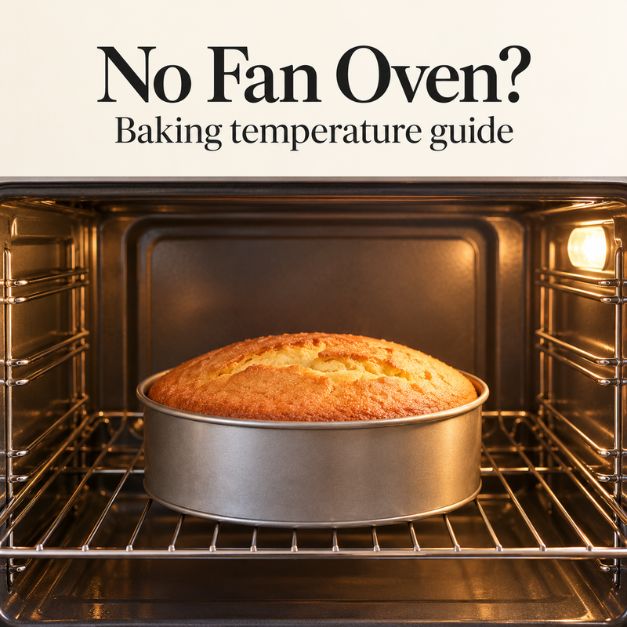
Yes. A conventional oven can bake excellent cakes. If your recipe gives only a fan temperature, adding approximately 20°C is a common starting point. For example, 150°C fan usually becomes 170°C in a conventional oven.
At CakeFlix, we suggest checking the recipe first. If it already provides separate fan and conventional settings, use the appropriate figure without making another adjustment.
| Recipe’s fan temperature | Conventional setting |
|---|---|
| 140°C fan | 160°C |
| 150°C fan | 170°C |
| 160°C fan | 180°C |
| 170°C fan | 190°C |
| 180°C fan | 200°C |
These are general starting points. Your appliance manual and recipe-specific instructions take priority.
A conventional oven heats the cavity without a fan circulating the cooking air. In many electric models, the usual baking function uses top and bottom heat.
“Fan-forced” and “convection” generally describe ovens that circulate heated air. Settings vary, so check your manual rather than identifying the function by the presence of a fan symbol alone.
Our oven settings guide for cakes and cupcakes explains baking modes and shelf positions.
It may, but there is no fixed number of minutes to add. Once you have adjusted the temperature, use the recipe’s timing as a guide and check for its stated signs of doneness.
Tin size, batter depth and your oven’s actual temperature all affect the result. Avoid opening the door early while a delicate sponge is setting.
Read our advice on baking in one tin instead of two if you are also changing the cake’s depth.
400°F converts to approximately 204°C, commonly rounded to 200°C conventional in baking charts. The usual corresponding fan setting is approximately 180°C fan.
However, if the recipe explicitly says 400°F convection, that is already a fan setting. Converting Fahrenheit to Celsius and adjusting for oven type are separate steps.
Preheat according to your appliance instructions and allow space around the tin. An oven thermometer can help reveal whether the actual temperature differs from the dial.
Nigella’s fan conversion guidance explains the usual 20°C adjustment.
Keep a short note of successful settings for your favourite recipes. For help developing the foundations, explore our guide to learning baking online and the CakeFlix Diploma.
Learning about how to make and store ganache is just one of 39 lessons covered in the CakeFlix Diploma, which, along with 1,800+ tutorials from 100+ of the world’s top cake artists, comes as part of your CakeFlix membership from only £5.17 a month (billed annually).
CakeFlix Diploma – Certified Learning

If u don’t have a fan oven and certain recipe state eg 150 degrees in fan oven what will u bake it in in an non fan oven and does this affect baking time as well
Yes. A conventional oven can bake excellent cakes. If your recipe gives only a fan temperature, adding approximately 20°C is a common starting point. For example, 150°C fan usually becomes 170°C in a conventional oven.
At CakeFlix, we suggest checking the recipe first. If it already provides separate fan and conventional settings, use the appropriate figure without making another adjustment.
| Recipe’s fan temperature | Conventional setting |
|---|---|
| 140°C fan | 160°C |
| 150°C fan | 170°C |
| 160°C fan | 180°C |
| 170°C fan | 190°C |
| 180°C fan | 200°C |
These are general starting points. Your appliance manual and recipe-specific instructions take priority.
A conventional oven heats the cavity without a fan circulating the cooking air. In many electric models, the usual baking function uses top and bottom heat.
“Fan-forced” and “convection” generally describe ovens that circulate heated air. Settings vary, so check your manual rather than identifying the function by the presence of a fan symbol alone.
Our oven settings guide for cakes and cupcakes explains baking modes and shelf positions.
It may, but there is no fixed number of minutes to add. Once you have adjusted the temperature, use the recipe’s timing as a guide and check for its stated signs of doneness.
Tin size, batter depth and your oven’s actual temperature all affect the result. Avoid opening the door early while a delicate sponge is setting.
Read our advice on baking in one tin instead of two if you are also changing the cake’s depth.
400°F converts to approximately 204°C, commonly rounded to 200°C conventional in baking charts. The usual corresponding fan setting is approximately 180°C fan.
However, if the recipe explicitly says 400°F convection, that is already a fan setting. Converting Fahrenheit to Celsius and adjusting for oven type are separate steps.
Preheat according to your appliance instructions and allow space around the tin. An oven thermometer can help reveal whether the actual temperature differs from the dial.
Nigella’s fan conversion guidance explains the usual 20°C adjustment.
Keep a short note of successful settings for your favourite recipes. For help developing the foundations, explore our guide to learning baking online and the CakeFlix Diploma.
Learning about how to make and store ganache is just one of 39 lessons covered in the CakeFlix Diploma, which, along with 1,800+ tutorials from 100+ of the world’s top cake artists, comes as part of your CakeFlix membership from only £5.17 a month (billed annually).
CakeFlix Diploma – Certified Learning
Hello Vinash
I can better explain the other way around. If a recipe says 170c that will be 150c fan oven. A good reference point is your appliance hand book, however if you don’t have one, as a rule of thumb there is a 20 degree difference. Fan ovens usually bake faster because the heat is distributed by circulation of the air produced from the fan. If you are baking in a convetional oven your temperature will be 170c and your baking time might be slightly longer. You would need to keep an eye on whatever you are baking This of course is just a guideline to follow. All ovens are different, some may bake hotter than others. The best way to check that your oven is properly calibrated is to invest in an oven thermometer. Pre heat the oven for approximately 20 minutes. If the thermometer reading inside your oven reads the same as what you have set the external dial you will know the temperature is correct. These are very inexpensive and could save you a lot of problems with over and under baking.
Hope this helps.