Popular tutorials to watch NOW




I made a cake recently for a friend of a friend which appeared to leave me in perfect condition however I got feedback from the friend that thecake was so wet in the middle that they couldn’t eat it. It was not undercooked but wet? They also said it didn’t taste nice and I always taste the of the cakes I make and it was lovely when I made and decorated it. Apart from being mortified as I have never had feedback like this before, I am keen to find out what could have caused it.
The cake was my usual vanilla sponge that I had frozen and fully defrosted (the sponge was fully cooked throughout and dry inside) before filling with jam and butter cream (they also said it wasn’t that the jam had soaked into the sponge) , I then covered in butter cream and covered with fondant as normal. I made the cake one day and it was picked up the following day and eaten the next day again.
I did advise to store somewhere cool and not in the fridge but I don’t know how it was stored, my friend will find out and come back to me.
This has seriously dented my confidence as I can’t think how this has happened.
Any help or advice would be appreciated
If your cake is still wet in the middle, it could be underbaked, contain too much moisture or have developed condensation after cooling, freezing or decorating.
A cake can look perfectly baked on the outside but still have a wet, sticky or soggy centre. Understanding when the problem developed is the first step towards identifying the cause.
The most common cause of a wet or gooey centre immediately after baking is that the cake hasn’t cooked through completely.
Possible reasons include:
Before removing a sponge cake from the oven, insert a skewer into the centre. It should come out clean or with a few dry crumbs, rather than wet batter.
For additional baking troubleshooting advice, see BBC Good Food’s guide to common cake problems.
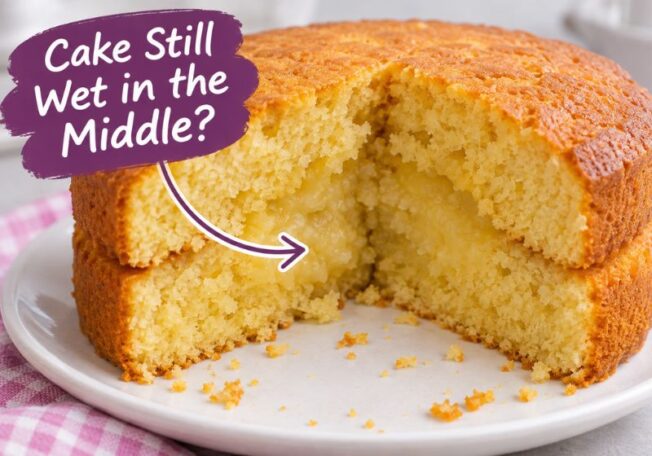
If your cake was properly baked but became wet or soggy later, the problem may be related to moisture introduced during cooling, freezing, filling or storage.
Condensation after freezing
If a cake is wrapped before it has cooled sufficiently, trapped moisture can affect its texture. Temperature changes during defrosting can also cause condensation.
Allow sponge cakes to cool completely before wrapping and freezing. Defrost them appropriately for their ingredients and avoid exposing them unnecessarily to warm, humid conditions.
Too much simple syrup
Simple syrup is useful for adding moisture and flavour to sponge cakes. However, applying too much can make the sponge heavy, sticky or unpleasantly wet.
If your cake is already moist, use syrup sparingly or leave it out altogether.
Moisture from fillings
Jam, fruit fillings and some buttercreams can introduce moisture into sponge layers.
A thin layer of buttercream around a softer filling can help limit moisture movement, although it won’t necessarily prevent it completely.
Incorrect storage
Cakes exposed to excessive heat, humidity or changing temperatures can develop condensation, particularly when covered with fondant.
Storage requirements depend on the ingredients used. Cakes containing perishable fillings must be refrigerated, even if refrigeration affects the appearance of the decoration.
If your cake is still in the oven and the centre contains wet batter, continue baking and check it regularly.
If the top is browning too quickly, loosely cover it with foil while the centre finishes cooking.
However, if the cake has already cooled and the middle is visibly raw or underbaked, it may not be possible to rescue it reliably. Do not serve a cake containing raw batter.
If a previously baked cake has become unusually wet after storage or decorating, investigate the cause before serving it. If you cannot establish that it has been handled and stored safely, it is better not to use it.
A few simple baking and decorating habits can help:
For cake makers selling to customers, receiving unexpected feedback about a cake’s texture can be upsetting, particularly when you’ve followed your usual recipe and baking methods.
If a customer reports that a cake was unusually wet, ask when it was cut, how it was stored and whether they can provide photographs or a sample.
This can help establish whether the problem arose during baking, filling, storage or after collection.
Take the concern seriously without immediately assuming the cause. If there is any possibility of a food safety problem, investigate it promptly rather than treating it simply as a complaint about texture.
Understanding ingredient ratios, baking temperatures, cooling and storage is essential for producing reliable results.
Our Cake Decorating Diploma includes essential cake baking techniques and troubleshooting skills to help you develop confidence and achieve more consistent results.
Remember, a cake that’s beautifully decorated still needs to be properly baked, carefully handled and correctly stored.
Learning about how to make and store ganache is just one of 39 lessons covered in the CakeFlix Diploma, which, along with 1,800+ tutorials from 100+ of the world’s top cake artists, comes as part of your CakeFlix membership from only £5.17 a month (billed annually).
CakeFlix Diploma – Certified Learning

Hi Blossom
First of all I’m so sorry to hear that your confidence has been knocked by the feedback. You have said you tasted the cake off cuts which were lovely, the cake was fully cooked and texture as should be. Did you use any simple syrup to add extra moisture to the sponge or did you just fill it? Sometimes if too much simple syrup is used, it can cause make the texture heavy, wet and soggy. I can’t really say that the moisture from defrosting may have caused the texture to become wet as you have stated it was dry. Was the cake completely cooled before it was frozen? If it wasn’t, this could have caused condensation build up in the layers. Denser cakes sometimes benefit from being frozen while slightly warm, however not so sponge cakes because of their delicate structure. A filled and decorated cake can sweat or become oily if not properly stored in a cool environment, this I think is the most likely cause after it left your care.
There are other reasons why a cake might seem wet. Things like adding too much wet ingredients and insufficient dry ingredients or subsituting ingredients in the given recipe eg oil for butter or adding fruit purees and buttermilk/sourcream/yougurt. You don’t appear to have done anything out of the ordinary.
I’m afraid I would have wanted to see and taste the cake! Did the customer bring you some of the cake to taste? … do you think that they may be after some kind of refund? I wouldn’t allow this incident to make you feel bad, there is no evidence to say you did something wrong.

Thank you so mch for your quick response. It has made me feel better reading it. I hadn’t added simple syrup and the cake was completely cool before carefully wrapping and putting in to the freezer and as you say, I hadn’t done anything unusual with the ingredients. The customer didn’t return the cake or even take a picture which has frustrated me as I too would like to have seen it as I really don’t understand it. I also didn’t get notified of any problems until 2 weeks after they collected the cake. I want to offer a refund so that there isn’t bad word of mouth about my cakes as I really take pride in every step of the process but my husbands says not too as I haven’t any evidence that there was anything wrong with the cake.
I love cake making and decorating and it’s a shame that this has happened but I will keep going. I have a cake in a few weeks that I need to add syrup to and now I’m scared to do so in case it becomes too wet!
Hi Blossom
If someone told me two weeks later that they didn’t like my cake I would ask them why they hadn’t contacted me sooner with the evidence! Honestly, I don’t think there was anything at all wrong with the cake, it’s just a con! Your husband is right in advising you not to give any kind of refund. A person with a genuine concern would have brought the cake back the next day. So much for friends of friends!!
Please don’t worry about using simple syrup . It’s a lovely way of adding a little moisture and flavour to cake and it helps to add an couple more extra days shelf life. If your sponge cakes are already very moist brush on just a little. Good luck with your up and coming cake, don’t worry about this incident, keep enjoying what you’re doing. 🙂 xx