How to Work with, Store and Deliver Ganached Cakes in Hot Weather
Ganache is one of the most versatile finishes in cake decorating. It creates sharp edges, a smooth surface and provides an excellent base for sugarpaste or buttercream. However, warm weather can quickly turn a perfectly finished cake into a stressful challenge.
This post is full of great hints and tips on how to manage your ganached cakes in hot weather. However, if you are new to ganache Paul Bradford has a range of short, east to follow tutorials on CakeFlix showing how to make, cover and store ganache.
Whether you are making cakes during summer, working in a warm kitchen or delivering celebration cakes on a hot day, understanding how ganache behaves in higher temperatures can make all the difference.
This guide explains the best ways to work with, store and deliver ganached cakes in hot weather while keeping them looking beautiful from kitchen to customer.
Let’s start with a true story when Paul and David first started with the cake shop. David was the cake delivery driver and would meticulously plan out his delivery schedule
On a hot summer’s day, his final delivery was to an outside catering event near Loch Lomond. He had the AC on full speed in the car, and up front in the driver’s seat it was very cold. But when he opened the back of the car to show the cake to the caterers it had completely melted! That was 25 years ago and a lot has been learned since then.
Why does ganache struggle in hot weather?
Ganache is made from chocolate and cream. Both ingredients become softer as temperatures rise. Although ganache is generally more stable than buttercream, it is still affected by heat.
Common problems include:
- Soft edges
- Sticky surfaces
- Sweating caused by condensation
- Sagging decorations
- Difficulty applying sugarpaste
- Damage during transport
Fortunately, most of these problems can be avoided with good preparation.
Choose the right ganache recipe
Not all ganache is created equal.
If you are working in warm conditions, increase the chocolate-to-cream ratio to produce a firmer finish.
As a general guide:
- Dark chocolate: around 2 parts chocolate to 1 part cream
- Milk chocolate: approximately 2.5:1
- White chocolate: around 3:1 because it contains less cocoa solids
A firmer ganache provides greater stability during decorating and transport.
Using quality chocolate with a higher cocoa content will also improve firmness and reduce the risk of melting.
Paul suggests that in warm temperatures the ratios should increase to:
- Dark chocolate: around 3 parts chocolate to 1 part cream
- Milk chocolate: approximately 3.5/4:1
- White chocolate: around 4/4.5:1 because it contains less cocoa solids
Keep your kitchen as cool as possible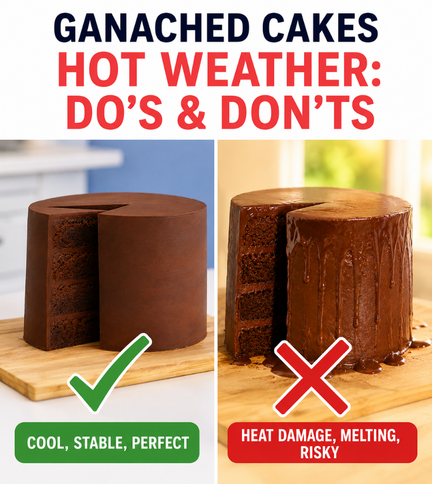
Your working environment has a huge impact on the final result.
Simple changes can make decorating much easier.
Try to:
- Close curtains to reduce direct sunlight.
- Use fans or air conditioning where possible.
- Decorate early in the morning.
- Avoid placing cakes near ovens or dishwashers.
- Work in short stages if the room becomes too warm.
Professional cake decorators often find that controlling the room temperature is just as important as the recipe itself.
Chill your cake correctly
Many decorators make the mistake of over-chilling ganached cakes.
Instead, allow the ganache to set until firm without freezing the cake.
If refrigeration is necessary:
- Chill only until the ganache is firm.
- Remove the cake gradually before decorating.
- Allow it to come to room temperature slowly.
Sudden temperature changes often cause condensation, which can affect sugarpaste, edible images and decorations.
Store ganached cakes safely
Storage depends on the filling and decoration.
If the filling requires refrigeration, keep the cake boxed inside the fridge. This helps reduce moisture forming on the surface.
If refrigeration is not required, store the cake in a cool, dry room away from sunlight.
Avoid garages, conservatories or warm kitchens during summer.
Always keep cakes covered to protect them from dust and humidity.
Delivering ganached cakes in hot weather
Transport is where many cakes suffer damage. As explained earlier with David’s cake melt disaster, the consequences can be horrific and waste hours and amazing work and your reputation too.
Before leaving:
- Chill the cake until firm.
- Place it on a strong cake board.
- Secure it inside a sturdy cake box.
- Use non-slip matting in your vehicle.
During transport:
- Run the air conditioning before loading the cake.
- Keep the cake level.
- Drive smoothly and avoid harsh braking.
- Never leave the cake in a parked car.
Even ten minutes inside a hot vehicle can soften ganache dramatically.
TOP TIPS
The passenger seat footwell is the best place to transport the cake in hot weather. It’s level and the AC is always more effective at the front of the car/van. If the cake needs to be in the back or boot, use a sealed plastic box and fill it with ice cubes and place as close to the cake as is safe to do so. This will help to keep the air temperature around the cake down.
Arrange with the venue where the cake will sit once delivered. Ensure that the table is not in direct sunlight, the room is cool, and where possible the cake set up at the last minute. Speaking with the wedding planner at the venue well before delivery will save a lot of stress when you reach the venue.
Deliver early in the morning of at all possible.
Can sugarpaste be used over ganache in summer?
Yes. In fact, many decorators prefer ganache under sugarpaste because it creates cleaner edges than buttercream.
However, allow the ganache to fully set before covering the cake.
If condensation appears after refrigeration, wait until the surface becomes completely dry before applying sugarpaste.
Trying to cover a damp cake usually leads to sticky sugarpaste and poor results.
What should customers know?
Good customer advice helps protect your reputation.
Include simple instructions such as:
- Store the cake in a cool room.
- Keep it away from direct sunlight.
- Avoid placing it beside windows.
- Refrigerate only if necessary.
- Bring refrigerated cakes to room temperature before serving.
Many decorators include these instructions on a printed care card with every order.
Final thoughts
Working with ganached cakes in hot weather does not need to be stressful. The key is understanding how heat affects chocolate and planning ahead.
Use a firmer ganache recipe, keep your workspace cool, allow cakes to set correctly and take extra care during transport. Small changes to your workflow can dramatically improve the finished result.
At CakeFlix, we teach professional techniques that help decorators produce beautiful cakes all year round. Whether you are creating celebration cakes for family or building a cake business, mastering ganache is one of the most valuable skills you can learn.
With the right preparation, your ganached cakes can remain sharp, stable and stunning, even on the hottest summer days.
Why not try our CakeFlix Diploma, which is a structured, accredited learning path to give you the foundations and skills to take your cake decorating to the next level. The CakeFlix Diploma along with 1,500+ cake tutorials and community support are all included in your membership.
Start a 7 Day FREE Trial and get access immediately!