Are YouTube Tutorials Limiting Your Cake Decorating Progression?
You’ve watched hundreds of tutorials. You’ve rewound the same thirty-second fondant technique four times. You’ve googled “why is my buttercream grainy” at midnight. And yet — something still doesn’t quite click.
If this sounds familiar, you’re not alone. Millions of passionate home bakers teach themselves to decorate cakes through a patchwork of YouTube videos, free blog posts, and trial and error. And while that resourcefulness is something to be proud of, there’s a hidden cost: you don’t know what you don’t know. Just imagine there was a cake decorating diploma with structured learning at an easily affordable price!
Youtube is great for getting started, but it comes to progressing it becomes difficult to find a clear or structured learning path for you to build upon the skills that you have learned. The CakeFlix Youtube channel has a small number of full tutorials, but more recently it is used for Short videos to create brand awareness, not necessarily teaching!
The Problem with Self-Teaching Cake Decorating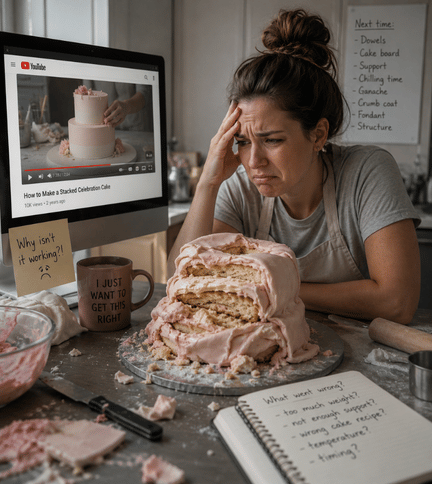
Free content is everywhere. The problem is that it has no memory of you.
A YouTube algorithm doesn’t know that you skipped the module on ganaching a cake before you attempted a sharp-edged fondant finish. A blog post doesn’t notice that your royal icing keeps cracking because your consistency is slightly off. No one is watching your progress and saying “before you try that, you need to know this.”
The result? Gaps. Silent gaps in your knowledge that quietly undermine your confidence and your cakes — even after years of practice.
Research from cake education specialists confirms this is one of the most common blind spots among self-taught decorators. You might be technically accomplished in the techniques you’ve picked up, but lack the foundational knowledge that professional cake decorators learn first. Things like understanding how temperature affects sugar work, or why a structurally sound tiered cake needs more than just dowels and hope.
These aren’t small details. They’re the difference between a decorator who gets by and one who consistently delivers.
Why Scattered Learning Keeps You Stuck
Self-teaching tends to follow interest rather than progression. You make a birthday cake, you watch a tutorial for that specific design, you muddle through. Next time, you do the same. What you rarely do is build skill upon skill in a logical sequence.
This creates a common pattern among passionate home bakers:
- High creative ambition — you have a strong visual eye and love the artistry of cakes
- Inconsistent technical foundations — some areas are solid, others have never been properly addressed
- Low confidence when it counts — you second-guess yourself at crucial moments because you’re not sure your method is actually right
- A ceiling on your progress — you keep producing cakes at roughly the same level, because you don’t have a roadmap to the next one
If you’ve ever finished a cake and thought “I think that’s okay… but I’m not sure why it worked” — that’s the gap showing.
What a Structured Learning Path Actually Changes
When learning is structured, everything shifts. You stop reacting to each cake as a fresh problem and start drawing on a solid base of knowledge. You understand why techniques work, not just how to copy them from a screen.
More importantly, you start to trust yourself.
A structured course gives you:
- Sequenced learning — each skill builds on the last, so nothing important is skipped
- Expert guidance — you learn from people who have refined these techniques professionally, not whoever happened to go viral that week
- Proof of achievement — something that marks your progress in a way a saved playlist never can
If you’ve ever asked yourself, “Is a cake decorating diploma worth it?”, you’re certainly not alone.
Many passionate home bakers reach a point where free YouTube tutorials and blog posts no longer seem to move their skills forward. You can make a nice birthday cake, perhaps even a wedding cake, but you’re never quite sure whether you’re using the best techniques or simply copying what you’ve seen online.
So, is investing in a cake decorating diploma really worthwhile?
For many decorators, the answer is yes. However, it depends on your goals.
Free Tutorials Are a Great Start
There’s no denying that YouTube has transformed cake decorating.
Thousands of talented cake artists freely share their techniques every day, making it easier than ever to learn new skills. In fact, many professional cake decorators started by watching online tutorials and experimenting in their own kitchens.
The challenge isn’t the quality of the tutorials.
The challenge is that they aren’t designed to teach you in a structured way.
One video might show you how to cover a cake in fondant, while the next teaches sugar flowers or gravity-defying cakes. They rarely explain which skills should be mastered first or why certain techniques are important before moving on.
Why Many Self-Taught Cake Decorators Stop Progressing
Learning randomly creates knowledge gaps.
You may become very good at modelling figures but struggle with smooth ganache.
You might produce beautiful flowers yet feel nervous stacking a tiered wedding cake.
Or perhaps you’ve made dozens of cakes but still wonder if you’re using the correct methods.
This is completely normal.
Without a structured learning path, it’s difficult to know what you don’t know.
That’s why many talented decorators feel as though they’ve reached a plateau despite spending years watching tutorials.
What Does a Cake Decorating Diploma Actually Give You?
A good cake decorating diploma is much more than a collection of videos.
It provides a logical learning journey where each skill builds upon the previous one.
Instead of guessing what to learn next, you’re guided through the core techniques that experienced decorators use every day.
Typically, a structured diploma includes:
- Baking and cake preparation
- Fillings and ganache
- Covering cakes with fondant
- Sugar flowers
- Sugar modelling
- Royal icing
- Wedding cakes
- Professional finishing techniques
As your knowledge grows, so does your confidence.
Rather than simply copying a design, you begin to understand why each technique works.
Is a Cake Decorating Diploma Worth It If You Want to Sell Cakes?
For many decorators, this is where a diploma really comes into its own.
Customers aren’t simply buying a pretty cake.
They’re trusting you to produce something that tastes fantastic, travels safely, supports multiple tiers and looks exactly as promised.
Structured learning helps remove much of the uncertainty.
Instead of relying on trial and error, you build consistent techniques that you can repeat with confidence.
Many cake decorators also find that earning a recognised certificate gives them greater confidence when marketing their business and speaking with potential customers.
How the CakeFlix Diploma Helps
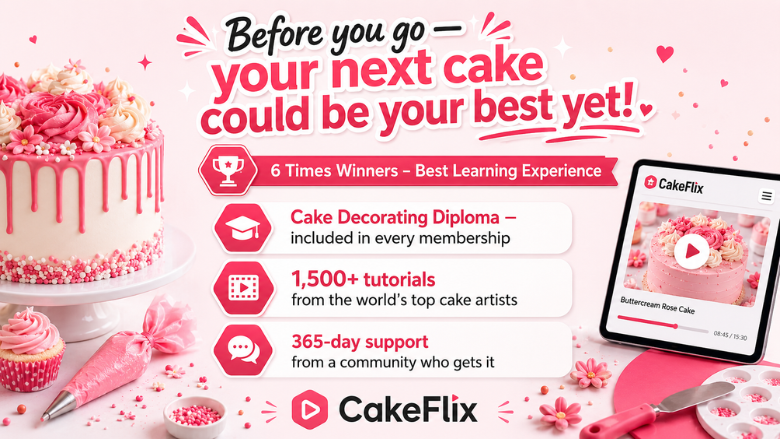
At CakeFlix, we created the CakeFlix Diploma to provide exactly this structured learning experience, which is included as part of your CakeFlix membership.
Rather than asking members to jump between hundreds of unrelated tutorials, the Diploma guides you through eight carefully planned modules, comprising 39 lessons and around 110 hours of learning.
Every lesson includes:
- Step-by-step video tuition
- Supporting learning materials
- A knowledge quiz
- Clear progression to the next lesson
The programme is taught by internationally recognised cake artist Paul Bradford, whose cakes have been created for HM Queen Elizabeth II, King Charles III and Prince Albert of Monaco.
Unlike many online courses, the learning materials were also developed alongside educational professionals to ensure the programme follows a logical, progressive structure.
More Than Just a Diploma
One of the biggest advantages of learning with CakeFlix is that the Diploma is only part of your membership.
You’ll also receive access to:
- Over 1,500 cake decorating tutorials
- More than 100 world-class cake artists
- The renowned CakeFlix Business Boot Camp
- Thousands of answered Cake Q&A questions
- Support from fellow members throughout the year
This means you can continue developing long after completing the Diploma.
Is a Cake Decorating Diploma Worth It?
If you simply enjoy watching the occasional decorating video, then free content may be all you ever need.
However, if you want to become a more confident decorator, improve your technical skills, create professional-quality cakes or even start a cake business, a structured diploma can save years of frustration.
Learning in the right order helps you build confidence with every cake you make.
That’s why thousands of decorators have chosen the CakeFlix Diploma as the next step in their cake decorating journey.
You can experience it yourself with a FREE 7-day CakeFlix trial and discover how structured learning could transform your cake decorating.
Frequently Asked Questions
Is a cake decorating diploma worth it?
Yes, if you’re serious about improving your skills, building confidence or starting a cake business. A structured diploma provides a clear learning pathway that free tutorials rarely offer.
Can I learn cake decorating online?
Absolutely. Many professional decorators have developed their skills through high-quality online courses that combine expert tuition with structured learning.
Do I need qualifications to sell cakes?
No formal qualification is legally required in the UK. However, completing a recognised diploma can improve your confidence, demonstrate your commitment to customers and help you develop professional techniques.
How long does a cake decorating diploma take?
The CakeFlix Diploma includes around 110 hours of guided learning spread across 8 modules and 39 lessons, allowing you to learn at your own pace.